
Frame-32
Frame-7
Frame-32
Frame-7

TL;DR:

  • The European SCPI for non-residents offers diversification, delegated management, and potentially attractive returns.
  • The main risks include foreign exchange, limited liquidity, and cross-border tax complexity.
  • A rigorous analysis of net-net return, taxation, and regular monitoring guarantee an optimized strategy.

Many expatriates and wealthy families too quickly dismiss European real estate investment trusts (REITs), convinced that tax complexities or geographical distance make this investment vehicle inaccessible from abroad. This is a mistake that can lead to costly missed opportunities. European REITs offer access to diversified commercial real estate, with potentially competitive returns and fully delegated management—two major advantages for non-resident investors. This article guides you step by step: understanding the real benefits, identifying specific risks, comparing offers using the right criteria, and implementing an investment strategy truly tailored to your international situation.

Key Points

PointDetails
European diversificationEuropean SCPIs allow you to diversify your assets outside of France with simplified management.
Specific risks for non-residentsCurrency, tax and liquidity management requires increased vigilance for expatriates.
Compare the net returnThe real criterion for comparison is the net-net return after taxes and fees, tailored to your situation.
Long investment horizonIdeally, invest for 10 years or more to maximize security and performance.
Expert guidance recommendedTailor-made advice streamlines the process and optimizes your return on investment.

Why European SCPIs attract non-residents

European real estate investment trusts (REITs) are attracting increasing interest from expatriates and high-net-worth families who wish to maintain exposure to real estate without the constraints of direct property management. Several factors explain this appeal, which goes far beyond a simple fad.

A genuine geographical and sectoral diversification

Unlike traditional real estate investments concentrated on a single property in a given city, European real estate investment trusts (REITs) offer access to diversified portfolios. Offices in Berlin, retail spaces in Amsterdam, logistics warehouses in Poland, student residences in Madrid: exposure is simultaneous across multiple real estate markets. This diversification naturally reduces the risk of vacancies or local depreciation. For an investor residing in Dubai, Singapore, or London, it's a concrete way to maintain a strong European presence without being limited to a single market.

THE wealth opportunities The investment opportunities offered by these vehicles cover a variety of segments: healthcare real estate, hospitality, managed residential, and prime office space. Therefore, selectivity is possible, depending on the investor's risk profile.

Potentially competitive returns

European SCPIs (French real estate investment trusts) offer distribution rates that can reach between 4% and 6% gross, depending on the year and the management company. This level remains attractive compared to other bond or money market asset classes. Of course, as market specialists point out, Past performance not guaranteed do not predict future returns, and a minimum investment horizon of 10 years is recommended to smooth out cycles.

For an expatriate looking to grow capital in euros without directly managing tenants or renovations, this recurring return remains a serious proposition.

Fully delegated management

This is probably the most compelling argument for a non-resident. The licensed management company handles all operational decisions: asset selection, lease management, property maintenance, rent collection, and dividend distribution. The investor receives their income in their foreign bank account and has access to quarterly or annual reports to track performance.

This flexibility is particularly valuable for those who invest from abroad and cannot actively manage a property remotely. The SCPI transforms a normally time-consuming asset into a virtually passive investment.

Depuis sa cuisine, une femme pilote ses placements à distance, alliant vie quotidienne et gestion financière.

A very real legal and tax flexibility

European SCPIs (real estate investment trusts) located outside of France can, in some cases, allow investors to avoid French social security contributions (17.2% taxable income) on real estate income, provided the investor is not a French tax resident. This point is crucial: it can significantly improve net returns. Furthermore,“access to the international real estate market Purchasing through a SCPI is much simpler legally than a direct purchase abroad, which would involve local notaries, complex legal arrangements and sometimes restrictions for non-residents.

Pro tip: Favor SCPIs with a solid history of cross-border management, with experienced teams in the targeted European markets and a management company that is transparent about its fees and allocation strategy.

European SCPI for non-residents: Risks and specific features

Investing in SCPIs from abroad is not without specific risks. Ignoring them would be a strategic error. Sound wealth management always begins with an honest assessment of the constraints.

Exchange rate risk: a reality not to be underestimated

If you receive your income in pounds sterling, dirhams, or dollars, and the SCPI distributes in euros, you are exposed to exchange rate fluctuations. An appreciation of the euro against your currency of residence can significantly erode your real return. Some SCPIs also invest in markets outside the eurozone, which adds an additional layer of currency risk. real estate risks Links to international markets must therefore be integrated into the overall portfolio analysis.

Reduced liquidity: a point to anticipate

SCPI units are not as easy to resell as publicly traded shares. A secondary market exists, but sales can take anywhere from several weeks to several months depending on market conditions. This can become problematic if liquidity is urgently needed. This is one of the reasons why specialists emphasize a long-term investment horizon.

The complexity of taxation and reporting

This is often the most dreaded point for non-residents. Depending on your country of residence and the location of the SCPI's assets, you may be subject to:

  • Taxation in the country of origin of the real estate income (France, Germany, Netherlands, etc.)
  • A reporting obligation in your country of residence according to local rules
  • The need to complete form 2047/IFU (declaration of foreign source income) if you remain taxable in France

As highlighted by specialist platforms, currency risk, lower liquidity, remote management and the 2047/IFU declaration are the four major areas of vigilance for a non-resident.

There international taxation The applicable rules depend on the bilateral tax treaties between France and your country of residence. These treaties often include tax credit or exemption mechanisms to avoid double taxation, but their practical application requires a case-by-case analysis.

Comparative table of main risks

Type of riskPotential impactLevel for non-residents
Exchange rate riskErosion of actual yieldRaised outside the eurozone
LiquidityResale timeModerate to high
TaxationPartial double taxationRaised without advice
Remote managementAdministrative follow-upModerate with serious company
Real estate marketValuation declineModerate over the long term

“Past performance is not indicative of future results. An investment horizon of more than ten years should be considered, and a thorough understanding of the specific risks associated with remote management and international taxation should be conducted before subscribing.” Specialists in the European SCPI market.

To avoid the SCPI pitfalls for non-residents the most common, the expatriation advice Specialists are essential, especially during the initial subscription process.
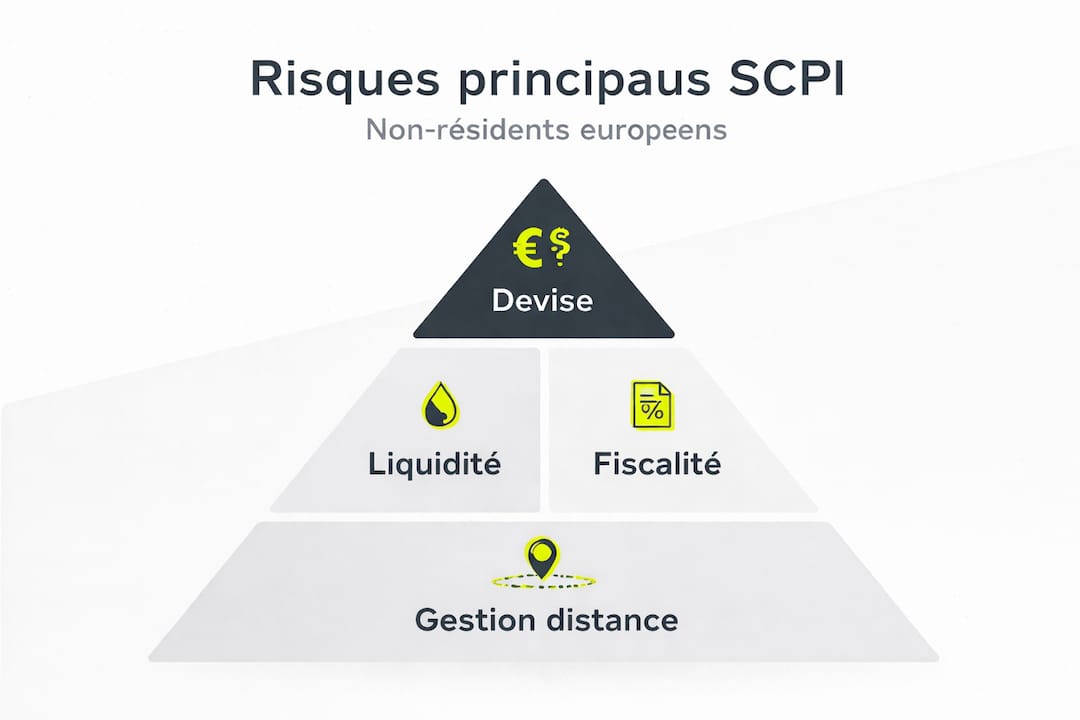
Visuel : classement des risques pour les non-résidents investissant en SCPI

Comparing European SCPIs for non-residents: key criteria

Not all SCPIs are created equal, and the selection must be based on specific criteria tailored to the realities of non-resident investors. Relying solely on the advertised distribution rate is a common mistake.

The four priority areas of analysis

  1. Cross-taxation between the country of investment and the country of residence. Some French real estate investment trusts (SCPIs) that invest primarily in Germany or the Netherlands benefit from more favorable tax treaties for non-resident French expatriates than purely French SCPIs. Analyzing the net impact of the applicable treaty is non-negotiable.
  2. The level of subscription and management fees. Entry fees can range from 7 to 12, and annual management fees from 10 to 15 of the rents collected. These costs directly impact net performance. The amortization period for entry fees, which can exceed five years depending on the distributed yield, must be considered.
  3. The net performance after taxes, actually received. What is called the “net-net return” is the only indicator that matters: the income received after withholding tax in the country of the asset, after any tax credit in the country of residence, and after management fees. net gains from European SCPIs constitute a subject in its own right that deserves detailed analysis.
  4. The effective geographical diversification of the SCPI's portfolio. A SCPI (French real estate investment trust) that is "European" in name but concentrated 80% in Paris does not offer the same diversification as an SCPI truly spread across several countries. Analyze the asset allocation in the annual reports.

Comparative table of SCPI types according to non-resident profile

CriteriaFrench SCPIpan-European SCPISCPI specializing in countries
social security contributionsApplicable if residentReduced or exemptVariable
DiversificationLow to moderateHighTargeted
Tax treatyFrance onlyMultipleA country
LiquidityModerateModerateVariable
Average costs8 to 10 %8 to 12 %9 to 11 %

To refine your choice, compare SCPI returns Taking into account the investor's tax profile is essential. A gross return of 5.5 % can become 3.2 % net-net for a tax resident in the United Arab Emirates, and 3.8 % for a resident in the United Kingdom, depending on the applicable treaties.

The specialist website highlights the key points of vigilance: operational risk, currency, complex taxation are the three axes to integrate into any serious comparison.

Pro tip: Never focus solely on gross yield or taxation. The only figure that matters is the net-to-net return actually received after all deductions, tailored to your personal circumstances. A difference of 0.5% in this return represents thousands of euros on a €200,000 investment over a 15-year period.

Investing in European SCPIs: practical steps for non-residents

Once the selection is made, the subscription and management process follows a clear logic. Here are the steps to follow for a successful investment from abroad.

The chronological stages of the investment

  1. Define your profile and your goals. Investment horizon, available amount, current and future country of residence, risk tolerance and wealth objective (supplementary income, appreciation, transfer): these parameters condition everything else.
  2. Analyze the applicable tax treaties. Before subscribing, check the tax treaty between France and your country of residence, as well as with the countries where the SCPI invests. This preliminary work will prevent unpleasant surprises when filing your tax return.
  3. Select the SCPI according to the criteria detailed above. Compare at least three to five vehicles on net-net return, fees, quality of management company and effective diversification.
  4. Gather the documents necessary for the subscription. As a non-resident, you will need to provide:
    • A valid form of identification (passport)
    • Proof of residence abroad (electricity bill, rental agreement)
    • An international bank account statement (foreign IBAN)
    • A certificate of foreign tax residence, if available
    • A Know Your Customer (KYC) form adapted for non-residents
  5. Subscribe through the management company or an authorized advisor. Direct subscription is possible, but a specialist intermediary often allows you to obtain better conditions and valuable administrative support.
  6. Organize the monitoring and reporting obligations. Form 2047/IFU is mandatory if you receive income from French sources. Even from abroad, some income remains taxable in France. Past performance is not indicative of future results, and this annual monitoring allows you to adjust your strategy if necessary.

Specific points of vigilance for non-residents

  • The long-term investment horizon is non-negotiable. Entry fees and the low liquidity of the shares make short-term investment counterproductive. Plan for a minimum of 10 years.
  • The currency for revenue collection. Specify your local currency to the management company to anticipate conversions and any potential exchange fees.
  • The evolution of your tax situation. Returning to France during the investment period radically changes the applicable tax regime. Anticipate this scenario in your strategy.
  • The quality and responsiveness of the management company. Remote management requires efficient digital tools, clear reports and easy access to a dedicated contact person.

The solution SCPI without management offered by specialist firms considerably simplifies this process for expatriates who wish to delegate all of the follow-up.

Practical tips to facilitate remote management

Activate the alerts and online dashboards offered by the management company. Keep a complete digital file of all your subscription documents, subscription forms, and annual statements. Prepare your tax return in advance each year by filing the necessary documents as soon as you receive your tax forms. And above all, review your asset allocation every two to three years with an advisor to ensure that your chosen SCPI remains aligned with your personal circumstances and objectives.

Our perspective on European SCPI investment for non-residents

Having assisted numerous expatriates with their SCPI investments, one conclusion is clear: most mistakes don't stem from poor vehicle selection, but from a misunderstanding of the overall context. Investing in European SCPIs from Dubai or Hong Kong is not simply a matter of "choosing the highest gross yield.".

The temptation of extreme tax optimization is real. Some investors spend more time trying to eliminate every tenth of a point of tax than analyzing the actual quality of the management company or the soundness of the underlying assets. This obsession can lead to suboptimal choices: a tax-efficient SCPI (French real estate investment trust) with mediocre assets remains a poor investment.

The real net return is the compass. Not the gross return, not siloed taxation. The question isn't "how much does this SCPI yield?" but "how much does this SCPI yield for me, given my specific tax situation, my fees, my currency, and my investment horizon?" These two questions have very different answers.

Furthermore, blindly passive management is a common pitfall. Once they've subscribed, many investors never revisit their choice for ten years. However, the European real estate market evolves, management companies change their strategies, and your own personal and tax situation can change radically, particularly if you move to a different country of residence. Active monitoring, even annually, is essential.

At Balmont Conseil, we firmly believe that European SCPIs (French real estate investment trusts) offer a solid diversification solution for expatriates and high-net-worth families, provided the project is carefully planned. This means a preliminary analysis of personal tax circumstances, a selection based on net-net returns, and regular monitoring adapted to the evolving needs of international life.

For those wishing to invest from abroad in a structured way, a tailored approach remains the only truly effective one. Each profile is unique, and a strategy copied from an expatriate neighbor may prove unsuitable, or even counterproductive, depending on the country of residence, the level of assets, and the inheritance objectives.

Optimize your European SCPI investment with personalized advice

European real estate investment trusts (REITs) offer genuine opportunities for non-residents and expatriates. However, their full potential is only realized with a strategy tailored to your specific situation: country of residence, tax treaty, investment horizon, risk profile, and wealth management objectives.

https://balmontconseil.com

At Balmont Conseil, we support expatriates, executives, and high-net-worth families in structuring and optimizing their international assets. Our tailored approach includes selecting SCPIs (French real estate investment trusts) suited to your tax profile, analyzing net-net returns, and providing ongoing support. Discover our wealth management guide for international investors, and explore our resources dedicated to the international wealth management strategy depending on your country of residence. Contact our experts for a personalized, no-obligation wealth assessment.

Frequently asked questions about investing in European SCPIs for non-residents

What tax criteria should be checked before investing in European SCPIs when you are a non-resident?

Check the tax laws of the country of investment, the country of residence, and any applicable double taxation treaties. Form 2047/IFU remains mandatory for income from French sources, even if received from abroad, and must be filed in advance of subscribing.

How to manage exchange rate risk when investing in non-euro SCPIs?

The risk of non-euro currency exposure can be reduced by favouring SCPIs that invest mainly in the euro zone, or by implementing currency hedging mechanisms adapted to your situation.

Is investing in European SCPIs suitable for non-residents for a short-term horizon?

No, this type of investment is designed for a minimum 10-year horizon in order to amortize entry costs and deal with the reduced liquidity of shares on the secondary market.

What documents are needed to subscribe to a European SCPI as a non-resident?

You will need to provide a valid passport, proof of residence abroad, an international bank statement, and possibly a certificate of foreign tax residence according to the KYC requirements of the management company.

Does past performance guarantee the future returns of SCPIs?

No, past performance is not guaranteed and is never indicative of future returns, particularly in an international context where real estate cycles and rates can vary significantly from one country to another.

Recommendation

Alexis Sagnier

With over 17 years of expertise in financial engineering, Alexis Sagnier assists executives and expatriates in securing their cross-border challenges.
Founder of Balmont Conseil in 2013, he designed a rigorous methodology — Augmented Consulting — which merges high human tax expertise with the analytical power of AI.

Summarize the article using AI


TL;DR:

  • The European SCPI for non-residents offers diversification, delegated management, and potentially attractive returns.
  • The main risks include foreign exchange, limited liquidity, and cross-border tax complexity.
  • A rigorous analysis of net-net return, taxation, and regular monitoring guarantee an optimized strategy.

Many expatriates and wealthy families too quickly dismiss European real estate investment trusts (REITs), convinced that tax complexities or geographical distance make this investment vehicle inaccessible from abroad. This is a mistake that can lead to costly missed opportunities. European REITs offer access to diversified commercial real estate, with potentially competitive returns and fully delegated management—two major advantages for non-resident investors. This article guides you step by step: understanding the real benefits, identifying specific risks, comparing offers using the right criteria, and implementing an investment strategy truly tailored to your international situation.

Key Points

PointDetails
European diversificationEuropean SCPIs allow you to diversify your assets outside of France with simplified management.
Specific risks for non-residentsCurrency, tax and liquidity management requires increased vigilance for expatriates.
Compare the net returnThe real criterion for comparison is the net-net return after taxes and fees, tailored to your situation.
Long investment horizonIdeally, invest for 10 years or more to maximize security and performance.
Expert guidance recommendedTailor-made advice streamlines the process and optimizes your return on investment.

Why European SCPIs attract non-residents

European real estate investment trusts (REITs) are attracting increasing interest from expatriates and high-net-worth families who wish to maintain exposure to real estate without the constraints of direct property management. Several factors explain this appeal, which goes far beyond a simple fad.

A genuine geographical and sectoral diversification

Unlike traditional real estate investments concentrated on a single property in a given city, European real estate investment trusts (REITs) offer access to diversified portfolios. Offices in Berlin, retail spaces in Amsterdam, logistics warehouses in Poland, student residences in Madrid: exposure is simultaneous across multiple real estate markets. This diversification naturally reduces the risk of vacancies or local depreciation. For an investor residing in Dubai, Singapore, or London, it's a concrete way to maintain a strong European presence without being limited to a single market.

THE wealth opportunities The investment opportunities offered by these vehicles cover a variety of segments: healthcare real estate, hospitality, managed residential, and prime office space. Therefore, selectivity is possible, depending on the investor's risk profile.

Potentially competitive returns

European SCPIs (French real estate investment trusts) offer distribution rates that can reach between 4% and 6% gross, depending on the year and the management company. This level remains attractive compared to other bond or money market asset classes. Of course, as market specialists point out, Past performance not guaranteed do not predict future returns, and a minimum investment horizon of 10 years is recommended to smooth out cycles.

For an expatriate looking to grow capital in euros without directly managing tenants or renovations, this recurring return remains a serious proposition.

Fully delegated management

This is probably the most compelling argument for a non-resident. The licensed management company handles all operational decisions: asset selection, lease management, property maintenance, rent collection, and dividend distribution. The investor receives their income in their foreign bank account and has access to quarterly or annual reports to track performance.

This flexibility is particularly valuable for those who invest from abroad and cannot actively manage a property remotely. The SCPI transforms a normally time-consuming asset into a virtually passive investment.

Depuis sa cuisine, une femme pilote ses placements à distance, alliant vie quotidienne et gestion financière.

A very real legal and tax flexibility

European SCPIs (real estate investment trusts) located outside of France can, in some cases, allow investors to avoid French social security contributions (17.2% taxable income) on real estate income, provided the investor is not a French tax resident. This point is crucial: it can significantly improve net returns. Furthermore,“access to the international real estate market Purchasing through a SCPI is much simpler legally than a direct purchase abroad, which would involve local notaries, complex legal arrangements and sometimes restrictions for non-residents.

Pro tip: Favor SCPIs with a solid history of cross-border management, with experienced teams in the targeted European markets and a management company that is transparent about its fees and allocation strategy.

European SCPI for non-residents: Risks and specific features

Investing in SCPIs from abroad is not without specific risks. Ignoring them would be a strategic error. Sound wealth management always begins with an honest assessment of the constraints.

Exchange rate risk: a reality not to be underestimated

If you receive your income in pounds sterling, dirhams, or dollars, and the SCPI distributes in euros, you are exposed to exchange rate fluctuations. An appreciation of the euro against your currency of residence can significantly erode your real return. Some SCPIs also invest in markets outside the eurozone, which adds an additional layer of currency risk. real estate risks Links to international markets must therefore be integrated into the overall portfolio analysis.

Reduced liquidity: a point to anticipate

SCPI units are not as easy to resell as publicly traded shares. A secondary market exists, but sales can take anywhere from several weeks to several months depending on market conditions. This can become problematic if liquidity is urgently needed. This is one of the reasons why specialists emphasize a long-term investment horizon.

The complexity of taxation and reporting

This is often the most dreaded point for non-residents. Depending on your country of residence and the location of the SCPI's assets, you may be subject to:

  • Taxation in the country of origin of the real estate income (France, Germany, Netherlands, etc.)
  • A reporting obligation in your country of residence according to local rules
  • The need to complete form 2047/IFU (declaration of foreign source income) if you remain taxable in France

As highlighted by specialist platforms, currency risk, lower liquidity, remote management and the 2047/IFU declaration are the four major areas of vigilance for a non-resident.

There international taxation The applicable rules depend on the bilateral tax treaties between France and your country of residence. These treaties often include tax credit or exemption mechanisms to avoid double taxation, but their practical application requires a case-by-case analysis.

Comparative table of main risks

Type of riskPotential impactLevel for non-residents
Exchange rate riskErosion of actual yieldRaised outside the eurozone
LiquidityResale timeModerate to high
TaxationPartial double taxationRaised without advice
Remote managementAdministrative follow-upModerate with serious company
Real estate marketValuation declineModerate over the long term

“Past performance is not indicative of future results. An investment horizon of more than ten years should be considered, and a thorough understanding of the specific risks associated with remote management and international taxation should be conducted before subscribing.” Specialists in the European SCPI market.

To avoid the SCPI pitfalls for non-residents the most common, the expatriation advice Specialists are essential, especially during the initial subscription process.

Visuel : classement des risques pour les non-résidents investissant en SCPI

Comparing European SCPIs for non-residents: key criteria

Not all SCPIs are created equal, and the selection must be based on specific criteria tailored to the realities of non-resident investors. Relying solely on the advertised distribution rate is a common mistake.

The four priority areas of analysis

  1. Cross-taxation between the country of investment and the country of residence. Some French real estate investment trusts (SCPIs) that invest primarily in Germany or the Netherlands benefit from more favorable tax treaties for non-resident French expatriates than purely French SCPIs. Analyzing the net impact of the applicable treaty is non-negotiable.
  2. The level of subscription and management fees. Entry fees can range from 7 to 12, and annual management fees from 10 to 15 of the rents collected. These costs directly impact net performance. The amortization period for entry fees, which can exceed five years depending on the distributed yield, must be considered.
  3. The net performance after taxes, actually received. What is called the “net-net return” is the only indicator that matters: the income received after withholding tax in the country of the asset, after any tax credit in the country of residence, and after management fees. net gains from European SCPIs constitute a subject in its own right that deserves detailed analysis.
  4. The effective geographical diversification of the SCPI's portfolio. A SCPI (French real estate investment trust) that is "European" in name but concentrated 80% in Paris does not offer the same diversification as an SCPI truly spread across several countries. Analyze the asset allocation in the annual reports.

Comparative table of SCPI types according to non-resident profile

CriteriaFrench SCPIpan-European SCPISCPI specializing in countries
social security contributionsApplicable if residentReduced or exemptVariable
DiversificationLow to moderateHighTargeted
Tax treatyFrance onlyMultipleA country
LiquidityModerateModerateVariable
Average costs8 to 10 %8 to 12 %9 to 11 %

To refine your choice, compare SCPI returns Taking into account the investor's tax profile is essential. A gross return of 5.5 % can become 3.2 % net-net for a tax resident in the United Arab Emirates, and 3.8 % for a resident in the United Kingdom, depending on the applicable treaties.

The specialist website highlights the key points of vigilance: operational risk, currency, complex taxation are the three axes to integrate into any serious comparison.

Pro tip: Never focus solely on gross yield or taxation. The only figure that matters is the net-to-net return actually received after all deductions, tailored to your personal circumstances. A difference of 0.5% in this return represents thousands of euros on a €200,000 investment over a 15-year period.

Investing in European SCPIs: practical steps for non-residents

Once the selection is made, the subscription and management process follows a clear logic. Here are the steps to follow for a successful investment from abroad.

The chronological stages of the investment

  1. Define your profile and your goals. Investment horizon, available amount, current and future country of residence, risk tolerance and wealth objective (supplementary income, appreciation, transfer): these parameters condition everything else.
  2. Analyze the applicable tax treaties. Before subscribing, check the tax treaty between France and your country of residence, as well as with the countries where the SCPI invests. This preliminary work will prevent unpleasant surprises when filing your tax return.
  3. Select the SCPI according to the criteria detailed above. Compare at least three to five vehicles on net-net return, fees, quality of management company and effective diversification.
  4. Gather the documents necessary for the subscription. As a non-resident, you will need to provide:
    • A valid form of identification (passport)
    • Proof of residence abroad (electricity bill, rental agreement)
    • An international bank account statement (foreign IBAN)
    • A certificate of foreign tax residence, if available
    • A Know Your Customer (KYC) form adapted for non-residents
  5. Subscribe through the management company or an authorized advisor. Direct subscription is possible, but a specialist intermediary often allows you to obtain better conditions and valuable administrative support.
  6. Organize the monitoring and reporting obligations. Form 2047/IFU is mandatory if you receive income from French sources. Even from abroad, some income remains taxable in France. Past performance is not indicative of future results, and this annual monitoring allows you to adjust your strategy if necessary.

Specific points of vigilance for non-residents

  • The long-term investment horizon is non-negotiable. Entry fees and the low liquidity of the shares make short-term investment counterproductive. Plan for a minimum of 10 years.
  • The currency for revenue collection. Specify your local currency to the management company to anticipate conversions and any potential exchange fees.
  • The evolution of your tax situation. Returning to France during the investment period radically changes the applicable tax regime. Anticipate this scenario in your strategy.
  • The quality and responsiveness of the management company. Remote management requires efficient digital tools, clear reports and easy access to a dedicated contact person.

The solution SCPI without management offered by specialist firms considerably simplifies this process for expatriates who wish to delegate all of the follow-up.

Practical tips to facilitate remote management

Activate the alerts and online dashboards offered by the management company. Keep a complete digital file of all your subscription documents, subscription forms, and annual statements. Prepare your tax return in advance each year by filing the necessary documents as soon as you receive your tax forms. And above all, review your asset allocation every two to three years with an advisor to ensure that your chosen SCPI remains aligned with your personal circumstances and objectives.

Our perspective on European SCPI investment for non-residents

Having assisted numerous expatriates with their SCPI investments, one conclusion is clear: most mistakes don't stem from poor vehicle selection, but from a misunderstanding of the overall context. Investing in European SCPIs from Dubai or Hong Kong is not simply a matter of "choosing the highest gross yield.".

The temptation of extreme tax optimization is real. Some investors spend more time trying to eliminate every tenth of a point of tax than analyzing the actual quality of the management company or the soundness of the underlying assets. This obsession can lead to suboptimal choices: a tax-efficient SCPI (French real estate investment trust) with mediocre assets remains a poor investment.

The real net return is the compass. Not the gross return, not siloed taxation. The question isn't "how much does this SCPI yield?" but "how much does this SCPI yield for me, given my specific tax situation, my fees, my currency, and my investment horizon?" These two questions have very different answers.

Furthermore, blindly passive management is a common pitfall. Once they've subscribed, many investors never revisit their choice for ten years. However, the European real estate market evolves, management companies change their strategies, and your own personal and tax situation can change radically, particularly if you move to a different country of residence. Active monitoring, even annually, is essential.

At Balmont Conseil, we firmly believe that European SCPIs (French real estate investment trusts) offer a solid diversification solution for expatriates and high-net-worth families, provided the project is carefully planned. This means a preliminary analysis of personal tax circumstances, a selection based on net-net returns, and regular monitoring adapted to the evolving needs of international life.

For those wishing to invest from abroad in a structured way, a tailored approach remains the only truly effective one. Each profile is unique, and a strategy copied from an expatriate neighbor may prove unsuitable, or even counterproductive, depending on the country of residence, the level of assets, and the inheritance objectives.

Optimize your European SCPI investment with personalized advice

European real estate investment trusts (REITs) offer genuine opportunities for non-residents and expatriates. However, their full potential is only realized with a strategy tailored to your specific situation: country of residence, tax treaty, investment horizon, risk profile, and wealth management objectives.

https://balmontconseil.com

At Balmont Conseil, we support expatriates, executives, and high-net-worth families in structuring and optimizing their international assets. Our tailored approach includes selecting SCPIs (French real estate investment trusts) suited to your tax profile, analyzing net-net returns, and providing ongoing support. Discover our wealth management guide for international investors, and explore our resources dedicated to the international wealth management strategy depending on your country of residence. Contact our experts for a personalized, no-obligation wealth assessment.

Frequently asked questions about investing in European SCPIs for non-residents

What tax criteria should be checked before investing in European SCPIs when you are a non-resident?

Check the tax laws of the country of investment, the country of residence, and any applicable double taxation treaties. Form 2047/IFU remains mandatory for income from French sources, even if received from abroad, and must be filed in advance of subscribing.

How to manage exchange rate risk when investing in non-euro SCPIs?

The risk of non-euro currency exposure can be reduced by favouring SCPIs that invest mainly in the euro zone, or by implementing currency hedging mechanisms adapted to your situation.

Is investing in European SCPIs suitable for non-residents for a short-term horizon?

No, this type of investment is designed for a minimum 10-year horizon in order to amortize entry costs and deal with the reduced liquidity of shares on the secondary market.

What documents are needed to subscribe to a European SCPI as a non-resident?

You will need to provide a valid passport, proof of residence abroad, an international bank statement, and possibly a certificate of foreign tax residence according to the KYC requirements of the management company.

Does past performance guarantee the future returns of SCPIs?

No, past performance is not guaranteed and is never indicative of future returns, particularly in an international context where real estate cycles and rates can vary significantly from one country to another.

Recommendation

Alexis Sagnier

With over 17 years of expertise in financial engineering, Alexis Sagnier assists executives and expatriates in securing their cross-border challenges.
Founder of Balmont Conseil in 2013, he designed a rigorous methodology — Augmented Consulting — which merges high human tax expertise with the analytical power of AI.

Summarize the article using AI